World Breastfeeding Week 2026 in Kenya: Dates, Theme & How to Get Involved

World Breastfeeding Week 2026 in Kenya: Dates, Theme & How to Get Involved

World Breastfeeding Week 2026 runs from 1st to 7th August, and this year’s global theme — set by the World Alliance for Breastfeeding Action (WABA) — is “Breastfeeding for a Sustainable Start in Life: Strengthen What Works.” In Kenya, the Kenya Association for Breastfeeding (KAB) is marking the week with bedside lactation support, hospital partnerships, and community outreach across Nairobi and beyond.

Whether you’re an expectant or new mother, a health facility, an NGO, a government partner, or a journalist covering the week, here’s everything you need to know — and how to plug in.

KAB is a proud partner of WABA's World Breastfeeding Week 2026
KAB is Kenya’s WABA-aligned partner for World Breastfeeding Week, connecting the global movement to mothers on the ground.

When is World Breastfeeding Week 2026?

World Breastfeeding Week is observed every year from 1–7 August, marking the anniversary of the 1990 Innocenti Declaration on infant and young child feeding. In Kenya, the week is recognised by the Ministry of Health’s Division of Nutrition and Dietetics Services alongside civil society partners like KAB.

What is the WBW 2026 Theme?

This year’s theme, “Breastfeeding for a Sustainable Start in Life: Strengthen What Works,” shifts the focus from starting new programmes to reinforcing what has already been proven effective — bedside counselling, baby-friendly hospital practices, workplace lactation support, and community-based peer networks.

For Kenya, that message lands with particular weight. The 2022 Kenya Demographic and Health Survey put the national exclusive breastfeeding rate at 60% — well above the global average, but essentially flat since 2014, and still short of the Ministry of Health’s own 80% target. The gains Kenya made between 2003 and 2014 were real; the task for 2026 is protecting and scaling them, not reinventing them.

Why This Matters for Kenya

  • 60% of Kenyan infants aged 0–5 months are exclusively breastfed (KDHS 2022) — ahead of the global average, but stalled for a decade.
  • Exclusive breastfeeding drops sharply with age: from roughly 84% of infants aged 0–1 month to just 42% by 4–5 months, as mothers return to work or lose access to consistent support.
  • The Ministry of Health’s national target is 80% exclusive breastfeeding a gap that bedside counselling, workplace lactation stations, and trained health-worker support are specifically designed to close.

These numbers are exactly why “strengthening what works” resonates in Kenya: the drop-off isn’t about awareness, it’s about mothers losing hands-on support at the exact moments they need it most in the first days postpartum, and in the first months back at work.

What KAB is Doing for World Breastfeeding Week 2026

As Kenya’s national association of certified lactation counsellors, KAB is marking WBW 2026 with activities designed to meet mothers and health workers exactly where the gap is widest:

  • Bedside lactation counselling in maternity wards across partner hospitals in Nairobi — one-on-one support on latch, positioning, and early breastfeeding confidence before discharge.
  • In-service training for nurses and midwives — short, practical refreshers on lactation management so every mother on the ward gets consistent, evidence-based guidance.
  • Prenatal breastfeeding classes for expectant mothers, covering latch, pumping, engorgement relief, burping, tandem feeding, and different breastfeeding styles — so mothers walk into the postpartum period already prepared.
  • Partnership and policy engagement with government, NGOs, and international health bodies to keep breastfeeding support embedded in Kenya’s broader maternal and child health system.

How to Get Involved

If you’re an expectant or new mother:
Reach out to KAB for bedside counselling, prenatal class schedules, or general breastfeeding support — no referral needed.

If you’re a hospital or health facility:
KAB partners with maternity wards to offer bedside counselling and nurse in-service training at no cost, delivered by certified volunteer counsellors. [Get in touch to schedule a session during WBW 2026 or beyond →]

If you’re an NGO, government office, or international partner:
KAB works alongside county and national health authorities, and international bodies aligned with WABA, on policy, training, and programme delivery. [Contact us to discuss partnership →info@breastfeedingke.com]

If you’re covering WBW 2026 for media:
KAB spokespeople are available for comment on breastfeeding trends, policy, and on-the-ground activities in Kenya throughout the week.

Frequently Asked Questions

When is World Breastfeeding Week 2026?
1st to 7th August 2026.

What is the 2026 World Breastfeeding Week theme?
“Breastfeeding for a Sustainable Start in Life: Strengthen What Works,” set globally by the World Alliance for Breastfeeding Action (WABA).

Who organises World Breastfeeding Week in Kenya?
World Breastfeeding Week is a global observance coordinated by WABA and WHO/UNICEF. In Kenya, it is marked by the Ministry of Health’s Division of Nutrition and Dietetics Services, alongside civil society partners including the Kenya Association for Breastfeeding (KAB).

Is there a breastfeeding support event near me in Nairobi during WBW 2026?
KAB runs bedside counselling and hospital-based activities across several Nairobi facilities during the week. [Contact us] for the most current list of participating locations.

How can I train as a lactation counsellor in Kenya?
KAB offers certified lactation counsellor training for health workers and community volunteers. [Visit our training page] to learn more.

The Kenya Association for Breastfeeding (KAB) is Kenya’s national association of certified lactation counsellors, and a WABA-aligned partner for World Breastfeeding Week. For partnership enquiries, contact us at info@breastfeedingke.org or 0723 365 660 / 0716 197 975.
Enough” Is a Myth: What Kenya’s Top Lactation Experts Want Every Working Mother to Know

Going back to work while breastfeeding is one of the most anxiety-inducing transitions a new mother faces. Will there be enough milk? Will the baby refuse the bottle? Will the nanny cope?

At a recent Kenya Association for Breastfeeding (KAB) forum, three of the country’s leading voices in maternal and infant health — Wangeci KiharaCiru Ciera, and Dr. Irene Nzioki — sat down to answer exactly those questions. What emerged wasn’t just advice. It was permission: permission to stop comparing, stop feeling guilty, and start building systems that work.

Here’s what they had to say.

1. Stop Comparing Milk. Start Trusting Your Body.

Wangeci Kihara opened with a myth she says causes more anxiety than almost anything else: the idea that there’s a universal “enough.”

There isn’t. If your baby is gaining weight, your supply is enough — for your baby. Whether you pump 70ml or 300ml is irrelevant if your child is thriving. Comparing output to other mothers, Wangeci says, does nothing but manufacture stress.

And stress is the real enemy. She put it simply: the body is biologically built to feed. The bigger obstacle is mental — mothers need to “feed their mind” with belief, because a mother’s mental state has a direct line to her milk supply.

Her advice? Choose your circle carefully. Surround yourself with mothers who’ve successfully breastfed while working. Who you spend time with shapes what you believe is possible.

2. Know Your Rights — Kenyan Law Is On Your Side

Ciru Ciera brought the legal receipts. Under Kenya’s Health Act of 2017, working mothers are entitled to protections many still don’t know exist:

  • One hour of protected time daily for expressing or breastfeeding — separate from your lunch break
  • Flexible use of that hour: take it all at once, or split it into three 20-minute sessions
  • A private lactation room with running water and an electrical socket — a bathroom does not qualify

This matters nationally, not just personally. Kenya’s exclusive breastfeeding rate slipped from 61% in 2014 to 60% in 2022. Ciera’s message: using your legal rights isn’t a favor to yourself — it’s part of reversing that trend.

She also introduced a framework worth remembering — the Three Bs:

  • Baby — needs a good latch (covering at least an inch of the areola) to trigger oxytocin release
  • Brain — a mother’s mental state directly affects milk-producing hormones
  • Breast — breasts are “factories, not warehouses.” They produce on demand. Skip removals, and the body reads that as a signal to slow down — because, as Ciera puts it, “nature abhors waste.”

Her practical tip for anyone without steady storage access, including market vendors and informal workers: hand expression is a lifesaver when there’s no electricity, and expressing straight into a clean cup works when there’s no pump.

3. Your Baby Is More Adaptable Than You Think

Dr. Irene Nzioki spoke for the one person in the room who couldn’t speak for themselves: the baby.

Her core message to guilt-ridden mothers — babies adapt brilliantly. In her clinical experience, she has never seen a baby who couldn’t adjust to a mother’s return to work. Framing work as providing for a child’s future, rather than abandoning the present, was central to her talk.

She gave mothers a simple checklist to know if their baby is thriving in daycare or with a nanny:

  • Does the baby light up, smile, or laugh when you return?
  • Are diapers consistently full?
  • Is the baby gaining weight and height steadily at clinic visits?

She also flagged something many caregivers get wrong: force-feeding. Holding a baby flat with the bottle at 90 degrees isn’t safe. Instead, she recommends paced feeding — baby upright, bottle horizontal, feed lasting 15–20 minutes — so the baby controls the pace and doesn’t overfeed. Overfeeding, she noted, is a leading cause of colic and disrupted sleep, which affects everyone’s next workday.

For expressed milk storage, her guidelines are simple to remember: 4–6 hours at room temperature, 4 days refrigerated, 6–12 months frozen.

And for mothers living with HIV: exclusive breastfeeding for six months, continuing up to two years, is recommended — provided the mother strictly adheres to ART and the baby remains on prophylaxis.

4. The Logistics That Actually Make It Work

Beyond the science, the panel shared the unglamorous, practical details that make or break a mother’s first weeks back:

  • Rehearse before you return. Around 6–8 weeks in, let the nanny run a full day solo while you stay hands-off. You’ll spot training gaps and learn your baby’s real daily milk needs before it counts.
  • Pick your return day wisely. Wangeci recommends starting back on a Wednesday or Thursday — a short first week gives you room to troubleshoot before the weekend.
  • You don’t need a freezer stash. Pumping “today for tomorrow” is enough. Chasing a massive frozen supply just adds pressure nobody needs.
  • Bottle refusal is normal. One mother tried 12 bottles before her baby accepted the 13th. If bottles remain a struggle, cup or spoon feeding are effective, government-recommended alternatives.
  • Fit matters. A wrong pump flange size — one mother was using 28mm when she needed 21mm — causes pain and low output. Get measured professionally before assuming your supply is the problem.
  • Frequency beats duration. Even 10 minutes of milk removal, done consistently, works better than occasional long sessions.

The Bigger Picture

Perhaps the most powerful reframe of the day came from Ciru Ciera, who reminded the room that this isn’t only a corporate mother’s issue. The same anxiety, the same biology, and the same need for support apply to “mama fuas”(laundry workers) and “mama mbogas” (market vendors) — women navigating breastfeeding with none of the infrastructure a formal workplace might offer.

That’s the thread running through all three talks: breastfeeding while working isn’t a personal failing to manage alone. It’s a systems problem — one that needs informed mothers, trained caregivers, compliant employers, and a supportive community. It’s exactly the work KAB exists to do.

Are you a mother preparing to return to work, or an employer looking to support breastfeeding staff? Reach out to the Kenya Association for Breastfeeding — we’re here to help you build a plan that works.

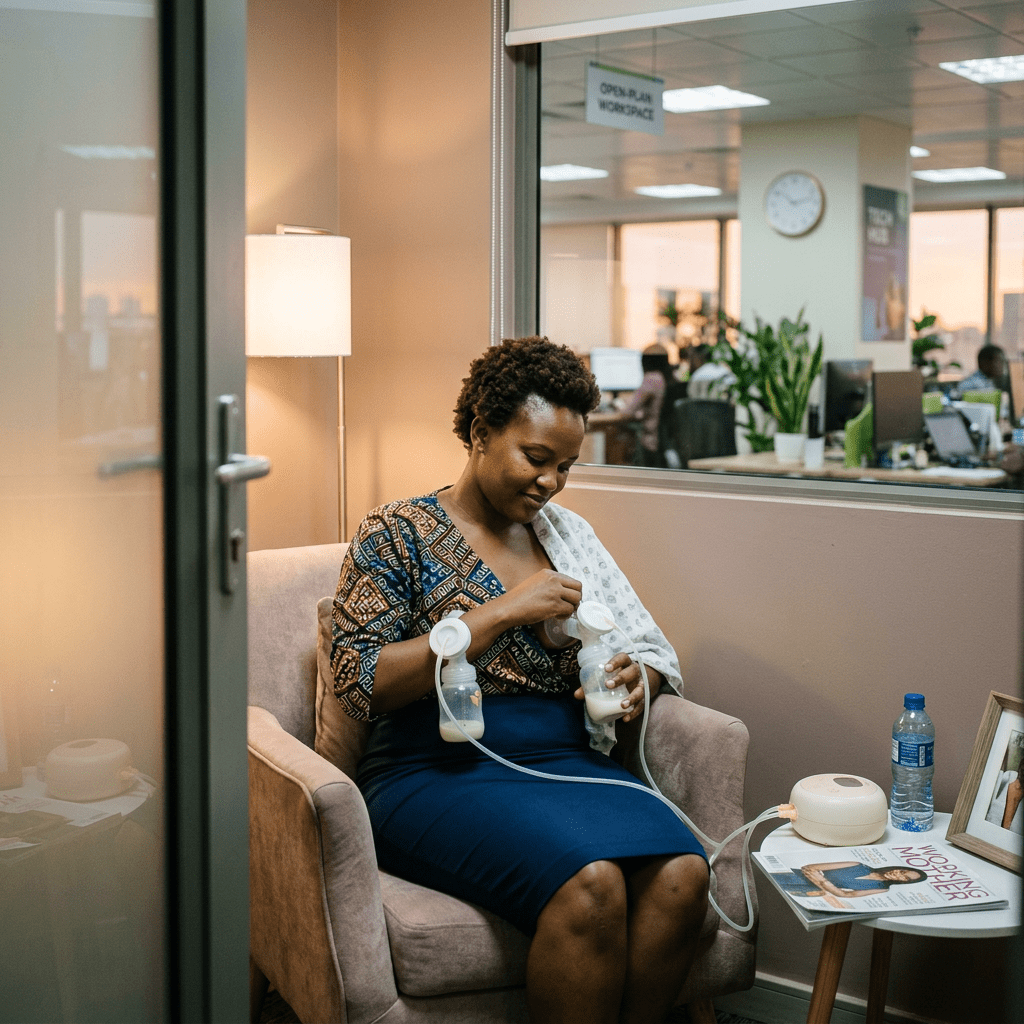
A woman using a breast pump while sitting in an office chair
A working mother comfortably pumps breast milk in a private office space.